
You feel the environment most when climate change shows up in everyday life: a smoky summer, a flooded commute, a water bill that keeps climbing, or an office environment that never seems to have clean air.
This guide turns the big topic into clear choices you can make at home, at work, and in your community.
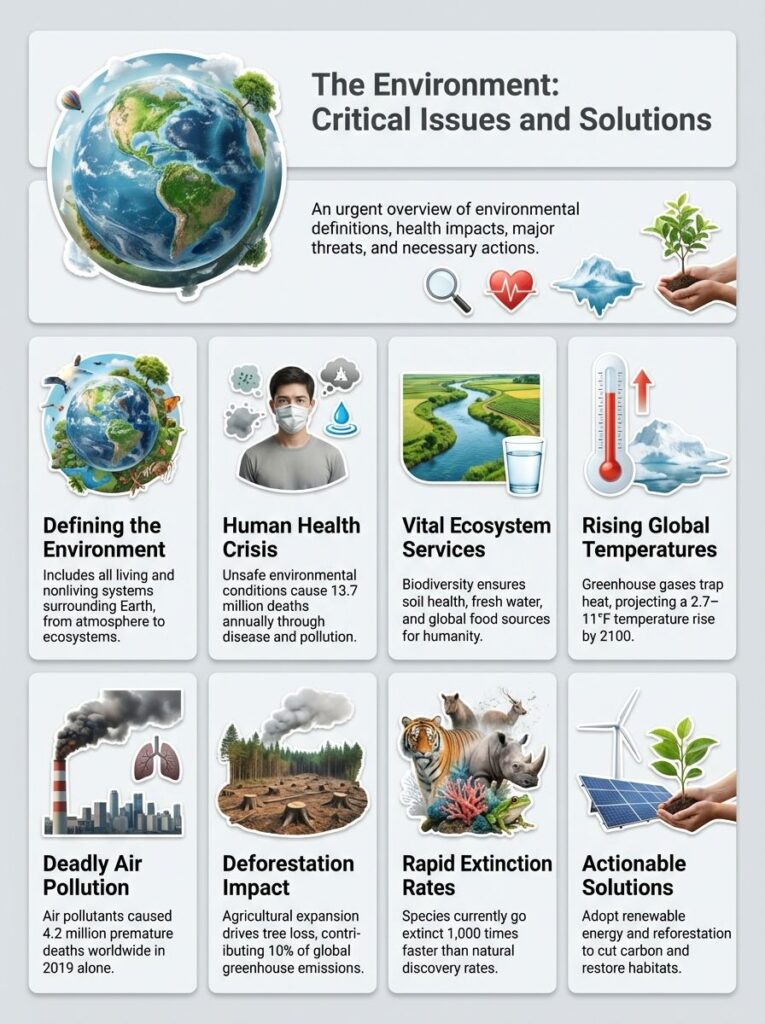
Environment means all living and nonliving parts of Earth, including ecosystems, the biosphere, climate, and built places like cities and farms. 1
This topic matters because unsafe environmental conditions link to nearly 24% of global disease deaths, about 13.7 million people each year, according to the WHO. 3
People cause much of the damage: agriculture and industry drive deforestation and habitat loss, add about 10% of human greenhouse gas emissions, and speed up biodiversity decline.
Air pollution alone causes an estimated 7.9 million premature deaths per year, from tiny particles, nitrogen oxides, sulfur dioxide, ozone, and volatile organic compounds.
The global population may reach 10.2 billion by the mid-2080s, which pushes resource use, raises water demand by about 600% since 1970, and strains soils and wildlife.
Biodiversity is dropping about 1,000 times faster than new species appear, and this loss threatens services like pollination, which gives roughly $550 billion in economic value.
Renewable sources supplied about 29% of the world’s electricity in 2020; solar and wind power grow fast, but storage and intermittency remain challenges; remote sensing helps guide reforestation and conservation to meet climate and health goals.
Keep reading for the definitions, the real-world issues, and the practical fixes that matter most.
Key Takeaways
- Unsafe environmental conditions cause about 13.7 million deaths yearly (≈24% of global fatalities) and could prevent ~25% of disease burden (WHO/UNEP).
- Climate change from CO2, methane, and nitrous oxide may raise temperatures ~1.5-6°C (2.7-11°F) from 1990 to 2100, causing sea-level rise and extreme weather (UNFCCC).
- Deforestation contributes about 10% of human greenhouse gas emissions and drives habitat loss, species declines, and biodiversity loss (IPCC).
- Pollution caused ~4.2 million premature deaths in 2019, as particulates, ozone, NOx, SO2, and VOCs raise respiratory and cardiovascular disease risks (WHO).
- In the US, environmental policies such as the Clean Air Act, Clean Water Act, Safe Drinking Water Act, NEPA, and the Endangered Species Act shape what businesses and communities must protect and measure.
Understanding the Environment: Definition and Types
The environment is the full set of conditions that surround life, both natural and human-made. That includes the earth’s atmosphere, the lithosphere, the world ocean, and built places like neighborhoods, highways, and farms.
If you want to act on environmental goals, start by naming what you can measure: your air, your water, your energy use, your waste streams, and the habitats around your home or workplace.
Additional Insights: The environment includes the atmosphere of the Earth, the global ocean, lithospheric plates, and living organisms. It covers both the natural environment and human-made settings. Key components such as the troposphere, hydrosphere, and biosphere work together to support an ecological community and help address human-caused climate change.
What is the environment, and what are its key components?
All living and nonliving things around life on Earth form the natural environment, including the earth’s atmosphere, lithosphere, and world ocean. Biotic factors include plants, animals, and microorganisms; abiotic factors include sunlight, temperature, water, and soil. 1
Energy flows from solar radiation captured by plants, and matter recycles through biogeochemical cycles and the oxygen cycle.
A practical way to use this: think in “systems,” not single problems. If you reduce fertilizer runoff, you protect water quality, reduce algae blooms, and help an ecological community recover over time.
Conservation and environmental stewardship guide sustainable resource management to limit biodiversity loss and protect ecological community health.
How do natural and built environments differ?
Natural environments include forests, creeks, ponds, and natural lakes. Built environments include cities, farms, offices, and other human-shaped landscapes, and they affect the natural world through land use, water demand, and pollution.
For most people, the fastest wins sit in the built environment because you can change it on purpose: building operations, transportation choices, and purchasing decisions can cut greenhouse gases and reduce exposure to pollution.
Researchers note that natural settings may not always boost working memory; some studies show no gain or even small drops, so complexity and immersion do not alone predict cognitive benefits. 2
- Natural environments tend to deliver “free” services like cooling, filtration, and habitat when they stay intact.
- Built environments can either amplify harm (heat islands, runoff, emissions) or reduce it (efficient buildings, clean energy, green infrastructure).
- Your office environment sits in the middle: it is built, but it directly controls your daily exposure to air quality and comfort.
Scientists stress ecological validity and detailed physical descriptions in research, and they call for further interdisciplinary research across earth sciences, biology, and psychology.
Why Does the Environment Matter?
The environment matters because it is the life-support system for people and the natural world. It is where clean air, fresh water, healthy soils, and stable climates come from.
If you run a household, manage a workplace, or lead a city team, the environment is also a budget issue: heat, storms, smoke, and contamination show up as repairs, sick days, and higher insurance and utility costs.
Reflection ↓
The stability of the natural environment influences daily life and economic budgets, affecting repair costs and utility expenses.
Why is the environment important for human survival and well-being?
A healthy environment saves lives and cuts health costs.
Clean air and a stable climate support safer water, safer food, and better health. Access to water and sanitation prevents disease, and nearly 25% of the global disease burden could be prevented with a healthy environment. 3
Unsafe environmental conditions cause about 13.7 million deaths each year, roughly 24% of global fatalities, and poor practices raise risks for infectious and noncommunicable diseases.
In the US, environmental protection often becomes actionable through laws and standards, such as Clean Air Act limits on common pollutants, the Safe Drinking Water Act for public water systems, and the Clean Water Act permit framework for discharges into waterways.
- At home: learn your main local risks (heat, flood, wildfire smoke) and set a simple plan for each.
- At work, treat indoor air as part of safety, like noise or ergonomics, with clear maintenance and operations ownership.
- In your community: support upgrades that cut exposure first (safer drinking water, cleaner transit, shade, and stormwater management).
Climate change and global warming add extreme weather, heat, and shifting disease patterns that harm people and ecosystems. Loss of biodiversity reduces natural checks on pests and disease, and they weaken the natural environment that supports food and medicine.
How does the environment support biodiversity and ecosystems?
The environment supports biodiversity by giving species what they need to survive: habitat, food, water, and the right climate ranges. When those basics stay stable, ecosystems provide services people depend on every day.
The environment supplies key ecosystem services, like provisioning, regulating, cultural, and supporting services that people use every day. 4
Biodiversity supports ecosystem functioning and resilience, and the diversity of species in an ecological community helps keep soil, water, and food systems working on planet Earth. 5
- Protected areas: parks, refuges, and locally protected open space reduce habitat loss and fragmentation.
- Working lands: farms, ranches, and forests can protect the natural environment with buffer strips, reduced tillage, and smarter water use.
- Backyards and campuses: native plants and fewer pesticides build small habitat “stepping stones” that help pollinators and birds move across built landscapes.
- Better decisions: tools like EPA’s EnviroAtlas help communities visualize ecosystem benefits so planning choices do not accidentally trade away flood protection or cooling.
Restoring degraded ecosystems and creating protected areas act as tools to protect habitats and fight biodiversity loss. Indigenous knowledge and local practices guide sustainable resource management, and research over three decades shows biodiversity promotes ecosystem functioning, though greater species diversity may increase resilience without proving long-term sustainability of services.
Collective action remains essential amid the global climate crisis.
How do overpopulation and resource depletion affect the environment?
Resource depletion is the environmental issue that often feels most local: water scarcity, degraded soils, and stressed fisheries show up as higher costs and tighter rules.
Population growth, set to hit about 10.2 billion by the mid-2080s, pushes farms into forests and speeds deforestation in many developing countries to meet food demand. 9
In the American West, the Colorado River remains a clear case study. The US Bureau of Reclamation’s 2026 shortage outlook continues to require cuts for Arizona and Nevada, and reduced deliveries to Mexico.
- For households: prioritize leak repairs, efficient fixtures, and climate-appropriate landscaping before you invest in new supply.
- For facilities: measure water use by process, then target the biggest loads (cooling towers, irrigation, and cleaning).
- For communities: invest in reuse, stormwater capture, and aquifer recharge where geology allows.
Overuse of soil, fishery collapse, and depleted aquifers add to biodiversity loss across the natural world and natural environment; unlimited growth on a planet with limited resources proves unsustainable.
Policies for population stabilization can slow resource depletion and protect ecosystems, from shallow crust effects to deep Earth processes like mantle plumes and outer core circulation that shape long-term climate patterns.
Consider these reflective questions ↓
What local signs point to resource strain? How does water scarcity affect community operations?
How Humans Impact the Environment
Humans impact the environment by changing land, water, and air at scale: we burn fuels that release greenhouse gases, convert habitats into built spaces, and introduce chemicals and waste into ecosystems.
For decision-making, it helps to separate impacts into what you control directly (energy, purchasing, waste) and what you influence indirectly (supply chains, commuting patterns, and local policy).
Summary Note ↓
Recognize the difference between direct actions and broader influences to support solutions that improve the natural environment.
What effects do industrialization and urbanization have on the environment?
Industrialization and FDI raise CO2 and methane levels, driving climate change and global warming. 10 Rapid urbanization increases energy demand, traffic emissions, impervious surfaces, and stormwater runoff, which raises biodiversity loss in the natural environment.
Research has linked economic growth, urbanization, and industrialization to rising pollution and ecological harm. 11
In the US, EPA’s greenhouse gas inventory summaries show transportation as the largest source of direct greenhouse gas emissions, and they also note that managed forests and other lands act as a net sink that offsets 13% of total gross emissions.
- For cities: reduce vehicle miles traveled through transit, safe walking networks, and zoning that lowers trip lengths.
- For businesses: set an emissions baseline for scopes you can control and target energy waste in HVAC, lighting, and plug loads first.
- For projects: build compliance into planning early, because laws like NEPA can require Environmental Assessments or Environmental Impact Statements for major federal actions.
Remote sensing and GIS show these trends, and the Environmental Kuznets Curve suggests that damage can rise with early growth before income may cut pollution.
Key Point ↓
Urbanization and industrial activities add to environmental challenges while creating chances to adjust policies that lower pollution.
How do agricultural practices and land use changes impact the environment?
Agricultural practices and land use changes impact the environment most through soil loss, nutrient runoff, water withdrawals, and habitat conversion.
Farmers often clear forests and expand fields, which causes soil erosion and habitat loss. Excessive fertilizer use and irrigation with contaminated water lead to pollution and lower crop quality.
killing fish and weakening local pollination, a clear sign of biodiversity loss. 12
- Nutrient management: match fertilizer to crop needs and timing to reduce losses to waterways.
- Soil protection: Cover crops and reduced tillage can cut erosion and improve water-holding capacity.
- Habitat support: field borders, hedgerows, and riparian buffers help rebuild an ecological community on working land.
- Program support: USDA’s NRCS Environmental Quality Incentives Program (EQIP) can help fund conservation practices that improve soil health and water quality.
Livestock production and heavy machinery burn fossil fuels and raise greenhouse gas levels, adding to global warming and climate change. Salinization and changing water supplies cut yields and threaten food security and public health.
Urban growth and deforestation reduce land for farming and damage ecological community services like pest control and pollination. Small fixes, such as better irrigation systems and precise fertilizer use, can cut pollution and help the natural world.
Reflection ↓
Agriculture and land use have clear links to environmental quality and food security, urging a move toward sustainable practices.
Solutions and Actions for Environmental Protection
Environmental protection works best when you pair personal action with systems change: cleaner energy, safer infrastructure, stronger standards, and practical enforcement.
You do not need a perfect plan to start. You need a short list of actions that cut greenhouse gases, reduce pollution exposure, and protect habitats where you live and work.
Summary Note ↓
Combining personal efforts with systemic improvements fosters measurable progress in environmental protection
What sustainable practices and renewable energy options exist?
Sustainable practices reduce harm at the source: lower energy waste, cleaner power, less toxic chemistry, and smarter land and water use.
For many homes and workplaces, energy efficiency is the first and cheapest step because it lowers bills while cutting climate change emissions.
- Solar: rooftop or community solar can cut emissions tied to electricity use, especially when paired with better insulation and efficient HVAC.
- Wind: utility-scale wind expands clean generation, and careful siting reduces risks to birds and bats.
- Heat pumps: high-efficiency electric heat pumps reduce fossil fuel use for heating and cooling in many climates.
- Smart controls: smart thermostats, demand response, and recommissioning can reduce waste in buildings without major construction.
- Cleaner fleets: route optimization and electrification reduce transportation emissions and improve local air quality.
We can cut emissions with smarter energy choices. Many options fit homes, cities, and office environments.
- Solar technology, like photovoltaic arrays, captures abundant sunlight; it needs large land or roof space and faces weather limits, yet solar and wind drove much of the 29% renewable share of global electricity in 2020. 13
- Wind power uses turbines onshore or offshore; it runs clean and scales fast, but it needs specific geography and can harm birds and bats without careful siting and monitoring.
- Hydroelectric dams provide efficient, steady power and storage potential; they can flood habitats, alter rivers, and demand high investment and social planning before construction.
- Geothermal plants tap heat from underground for stable baseload energy; they perform well where geology allows, but sites may risk land subsidence and are location-dependent.
- Biomass energy can be carbon-neutral when managed, yet it can compete with food crops, require large amounts of land, and pressure the natural environment and ecological community health.
- Battery systems, like lithium-based storage, smooth intermittency and support grid integration; they face material supply, recycling, and cost challenges that regulators must address.
- Smart meters, demand response, and energy-efficiency upgrades cut waste in homes, offices, and industry; these tools lower bills, reduce global warming emissions, and help address climate change.
- Conservation work, reforestation, and protected areas restore ecosystems and fight biodiversity loss; these actions support the natural world and strengthen ecological community resilience.
For US households, IRS guidance explains that the residential clean energy credit generally covers 30% of eligible costs for solar, small wind, geothermal, and battery storage through 2032, and the energy-efficient home improvement credit generally has annual limits (commonly up to $1,200, with a separate limit up to $2,000 for certain heat pumps).
Key Observation ↓
Renewable energy options offer viable paths to reduce greenhouse gas emissions and promote energy efficiency in both the natural environment and the office environment.
How do conservation and reforestation efforts help the environment?
Conservation and reforestation help by restoring habitat, stabilizing soils, protecting watersheds, and drawing down carbon through the carbon cycle, especially when projects protect existing mature ecosystems and use native species.
In the US, programs such as the USDA Forest Service Urban and Community Forestry Program help communities expand tree canopy, reduce heat islands, and improve air and water quality where people live and work.
- Afforestation and reforestation meet global climate targets and UN SDGs, removing CO2 and slowing global warming; A/R programs also help manage forests and boost climate resilience with clear targets and funding.
- A/R programs curb deforestation and improve socio-economic conditions, creating jobs, supporting local communities, and reducing pressures that drive habitat loss and zoonotic disease spread from degraded forests.
- Urban forestry adds shade, cools the office environment and cities, and delivers ecosystem services that reduce heat in the tropics and temperate zones faced with climatic changes and urbanization.
- Restoration of degraded ecosystems and protected areas rebuild ecological communities, increase biodiversity, and reverse species declines that cause long-term biodiversity loss across the natural world.
- Satellite remote sensing and drones speed forest monitoring, detect illegal clearing, and track regrowth; tools such as Landsat support long-term monitoring of Earth’s surface change.
- Conservation programs fund education courses that change behavior; our systematic review found that environmental education contributes to better conservation outcomes and improved environmental quality metrics.
- Reforestation strategies pair native seedlings with soil restoration, which heals endorheic basins and fragile habitats; they also lower erosion, protect watersheds, and reduce risks tied to subducted soils in some regions.
- Protected areas and active restoration reduce habitat fragmentation, help species adapt to climatic changes, and provide clear metrics for progress toward SDGs and targets tied to the definition of life and ecosystem health.
Reflection ↓
Conservation efforts support environmental sustainability and community well-being by protecting essential ecosystem services.
Conclusion
The environment covers the natural world, human spaces, and the networks that connect them.
It matters because plants, animals, and people all depend on air, water, and soil, and climate change makes those basics harder to protect.
We face climate change, global warming, pollution, deforestation, and biodiversity loss.
Industry and farming reshape landscapes and affect both rural land and the office environment.
Scientists respond to climate change denial with evidence, and research on psychology and climate change helps communities communicate risk without panic.
Communities can choose renewable energy, reforestation, conservation maps, and monitoring tools like sensors and ExoBase data to act now.
Reflection ↓
The interdependence of the natural world and human society calls for sustained efforts to preserve our environment.
FAQs
1. What does “environment” mean?
Environment means the space around living things, from the natural world to your office environment; it includes the natural environment on Earth and places like the exobase on other planets. It covers systems, such as a coral reef ecological community or an oak forest ecological community, that work together.
2. Why does the environment matter?
It keeps life alive by supplying clean air, water, and food, and it supports people and species. Climate change and global warming stress these systems and drive biodiversity loss, and psychology and climate change show how people react to those risks.
3. What issues is the environment facing now?
Rising global warming and long-term climate change harm habitats and food webs, and they speed biodiversity loss in many places. Human actions also damage the natural environment and the wider natural world.
4. How do people help, and what problems get in the way?
People can act by protecting habitats, using cleaner energy, and making ecologically smart choices; workplaces can also change their office environment to reduce waste—misinformation, including claims that climate change is a hoax, and bad habits —by taking slow but real action.
Disclaimer: This content is for informational purposes only and is not a substitute for professional advice. The information has been compiled using publicly available data from sources such as WHO, IPCC, and UNFCCC, and is informed by research in geoscience and environmental studies.
No sponsorship or affiliate links influence the content of this guide.
References
- https://pmc.ncbi.nlm.nih.gov/articles/PMC8809530/
- https://evs.institute/fundamentals-of-environmental-science-and-ecology/understanding-environment-definitions-core-principles/
- https://www.sciencedirect.com/science/article/pii/S0272494425002464
- https://www.who.int/health-topics/environmental-health
- https://www.sciencedirect.com/science/article/pii/S2212041614001648
- https://pmc.ncbi.nlm.nih.gov/articles/PMC9300022/
- https://pmc.ncbi.nlm.nih.gov/articles/PMC7044178/
- https://www.ifaw.org/journal/what-is-deforestation-impact-wildlife (2024-07-31)
- https://pmc.ncbi.nlm.nih.gov/articles/PMC6871202/
- https://www.mdpi.com/2673-8392/5/2/45
- https://pmc.ncbi.nlm.nih.gov/articles/PMC8739025/
- https://www.sciencedirect.com/science/article/pii/S2095263524000530
- https://pmc.ncbi.nlm.nih.gov/articles/PMC5814744/
- https://www.sciencedirect.com/science/article/pii/S2666202723002136