


The concept of solar energy has been around for quite some time now. Most energy production methods are becoming greener every day. Then there came the idea of solar panels. That went on well, and they have been in use for decades. But now imagine a roadway made of solar panels. That’s the story you wouldn’t believe can be achieved.
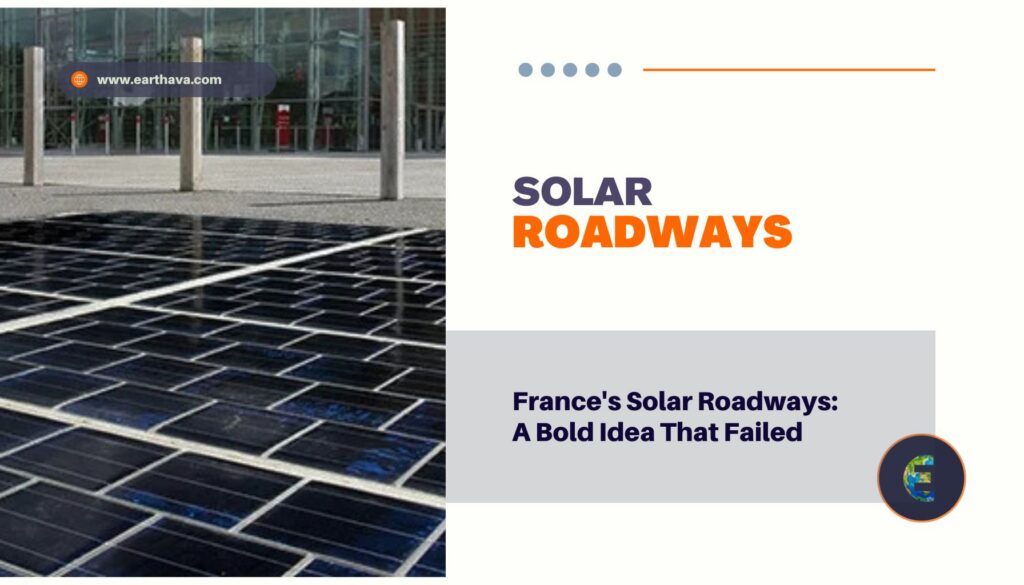
The idea
The French government, through the Ministry of Ecology and Energy, is planning to install solar panels on the existing 621 miles of roadway. This is approximately 1,000 kilometers of road pavement. This is an energy-generating project which is expected to take about five (5) years after its commencement. The project was under research for 5 years (from 2009 to 2014), and after all the testing and adjustments, the prototype was rolled out and tested in 2015.
Update: The Wattway trial was completed and has since been deemed a failure. The full 621-mile rollout never happened.
It was then that the company, Colas, was officially given the tender for constructing the proposed 621 miles of solar pavements. The Waterway panels, as they are called, are made extremely thin but very tough. In fact, they can withstand any road usage, including heavy trucks and chain caterpillars. The panels are 7 mm thick or rather a quarter inch thick, and are made up of photovoltaic cells put in a tile-like manner, which are then mounted on a silicon layer. It is the silicon layer that will be placed on top of the existing roads.
Update: The panels did not withstand real-world traffic conditions as expected. Colas acknowledged the road surface deteriorated well ahead of schedule.
However innovative the project may seem to be, it is not actually the first one to be put in place or even researched. In fact, the Netherlands government has done a similar project in 2014, but for them, they set up solar panels on bike pavements, which differs from the project in France, which will install the panels on roadways used by all kinds of vehicles. The 70-meter project in the Netherlands worked well, and it, in fact, exceeded their expectations in terms of total energy generated (3,000 kW/h of electricity).
Update: The Netherlands bike-path model continued to show promise, with a second route opened outside Eindhoven. However, heavier-traffic pilot roads were abandoned by 2019. The technology works better on bike paths than on vehicle roads.
The numbers
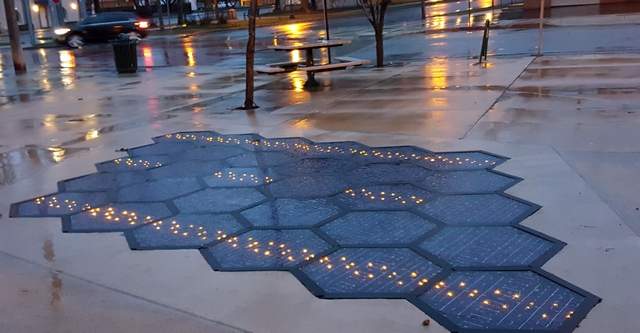
After completion, 1 km of the solar roadways is expected to produce enough electricity to power a small town of up to 5,000 inhabitants. This mathematically implies that 20 m² of the pavement installed with solar panels will produce sufficient electricity for a single household. “The long-term effect of the project, if successful, would be to furnish about 5 million people with electricity or about 8 percent of the French population,” said France’s minister of Ecology and Energy Ségolène Royal.
Update: These projections were not met. Real-world output fell to roughly a quarter of the stated goal by 2019, and the larger 5-million-person target was never pursued.
Generally speaking, the French roads are usually unoccupied for about 90% of the day. This will imply that in that 90% of the day, the panels will be properly exposed to the sunlight, which then will mean that green energy will be produced. Forbes reported that the first physical test of the panels on a road will be done on a 1km stretch of road in order to monitor the progress.
This test will also see to the production of enough energy for about 5,000 people. Wattway originally projected a 10-year lifespan in heavy traffic and 20 years on quieter roads. In practice, sections of the Normandy trial needed to be demolished within two years of opening.
Pros
The project will generate high amounts of green energy. This is the bottom line of the idea. So the whole project will enable the production of enough electricity to be used in homes as well as street and traffic lights. Injecting such high amounts of energy into the grid will lower the amount of energy produced through non-renewable energy methods, thus conserving the environment as a result of fewer CO2 emissions.
The project will not require farmlands or rooftops. The roads currently have one use – for motorists. Adding another purpose to them without disrupting the regular usage would be pretty much economical.
The existing road structure will be maintained. There will be no need to tear up the existing forms of roadways to install the solar panels. They are designed to fit on the road, still in their normal form.
The solar panels are skid-resistant. The silicon layer mounted on top of the solar panels ensures that they provide enough grip to the tires of the vehicles, thus reducing the chances of skidding on the roads, just like normal roads.
Durability. The investment is expected to last for many years to come. This means that it is in a position to withstand harsh climatic conditions, including rain, and still maintain its normal functioning.
Update: These advantages remain theoretically valid, but the Normandy trial showed that real-world conditions, shade, weather, heavy vehicle wear, and panel positioning significantly reduced the actual output and durability compared to projections.
Cons
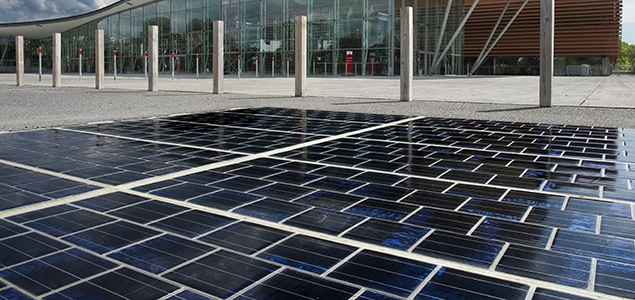
The project will be an expensive venture. Without any doubt, the project will lead to a high amount of revenue being directed to it. It will be generally costly.
It is not ideal for all roads. Some French roads are full of traffic. These would be some of the points on the roadways that would not be ideal for installations. Also, roads covered with shade for most of the day will also be unreliable for this venture.
The Normandy trial, which ran from 2016 onward, confirmed many of these risks. The road deteriorated faster than expected, fell well short of energy targets, and the full 1,000km rollout plan was shelved.
Maintenance might be costly. Regular maintenance, like keeping the panels clean as well as repairing them when they are not functional, might also cost the government a lot more than they expect.
The French solar roadway experiment ultimately served as a valuable, if costly, lesson. The technology works better in lower-traffic settings like bike paths, as the Netherlands showed. Most researchers now point to solar canopies over roads and rooftop installations as more practical paths forward for solar infrastructure.
 Earthava is an environmental collective designed to turn awareness into impact. From deep dives into ecology to daily sustainable swaps, we provide the tools and intel you need to protect the ground you stand on.
I cannot say that this is a very bright idea. A road surface is designed for an entirely different purpose. The pounding of tyres from cars and heavy trucks coupled with skids, ice and even the occasional vehicle fire means that sections of the road will need to be closed for repairs and maintenance. Far more sense to use the roadside or verges. These allow ease of access and the road will not need to be closed for maintenance of panels.