


Eco-brutalism is raw concrete that acknowledges plants’ existence.
Still, same concept as classic brutalism, but without all the environmental consequences.
Cement alone accounts for around 8% of global CO₂ emissions. Eco-brutalist projects don’t ignore that number; they build around it: vertical gardens climbing concrete facades, solar panels set into the roofline, rainwater systems built into the design instead of bolted on after.
Moshe Safdie did an early, unintentional version of this back in 1967 with Habitat 67, a building of 354 stacked concrete modules, each with its own garden. Sixty years later, that idea still stands and grows to be a solution for the current climate circumstances.
What Is Eco-Brutalism? The Ultimate Guide to Sustainable Modern Design
Eco-brutalism keeps brutalism’s core move, raw structural concrete left exposed, and adds a layer post-war architects never planned for: the living organisms are the ones doing the real work here.
Defining Eco-Brutalism: A Fusion of Concrete and Greenery
Vertical gardens climb the concrete instead of hiding behind glass. Solar panels sit flush with the facade instead of getting bolted on as an afterthought. Rainwater gets captured and reused instead of running straight to the storm drain.
None of this softens the brutalist look; it is still concrete, but with eco-friendly features.
A 2025 measurement across four living walls and one green facade found summer surface temperatures dropping by as much as 13.7°C compared to bare concrete. Now this is just hard to ignore, and it is real proof that it is actually working.
How Eco-Brutalism Differs from Traditional Brutalism

Post-war brutalism wasn’t built with any of this in mind. Eco-brutalism, on the other hands refine the whole concept, without changes to its core.
| Aspect | Traditional Brutalism | Eco-Brutalism |
|---|---|---|
| Materials | Steel, bare concrete | Carbon-absorbing concrete, recycled metals |
| Energy Use | High | Solar-integrated, passive cooling |
| Nature Integration | Minimal | 40% air quality boost with green walls |
Concrete’s sustainability problem doesn’t disappear just because a building is covered in vines, but the certifications now rewarding durability alongside eco-ethics suggest the industry knows that.
Tbilisi’s old Ministry of Highway Construction building, the one now mostly hidden under decades of unplanned vine growth, gets cited constantly as an eco-brutalist icon.
The Origins and Evolution of Brutalism
Brutalism came out of postwar Britain with several goals: Finding cheap housing for people, using materials that didn’t need importing, which in that case was concrete, of course.
Thinking about the environmental impact seemed a luxurious thought back then that was not a priority because its impact was not clear enough, especially in post-war situations.
Post-War Pragmatism: The Birth of Brutalist Architecture
Alison and Peter Smithson answered London’s 1950s housing shortage with Robin Hood Gardens, two long concrete blocks in Poplar, one ten storeys, one seven, wrapped around a shared green space with elevated walkways the Smithsons called “streets in the sky.” It was radical in its ambition and, for decades, deeply unpopular.
Historic England refused to list it, twice, and demolition started in 2017; a preservation campaign backed by Richard Rogers, Zaha Hadid, and Renzo Pianocouldn’t stop the demolition.
So most of it is gone now. A single salvaged fragment sits in the V&A’s permanent collection, which is a strange kind of afterlife for a building this contested.
Eastern Bloc architects took the same material in a different direction, building monolithic civic structures meant to project state permanence. Poland’s Spodek Arena and Bulgaria’s Buzludzha Monument both come out of that instinct, concrete as ideology made physical.
From Utopian Ideals to Modern Revival
Brutalism spent the 1980s and 90s as the style everyone hates, blamed for cold, unlivable public housing and demolished on that reputation more than once. But in January 2025, Boston officially designated its Brutalist City Hall a local landmark, protecting it from demolition after nearly two decades of advocacy. Still good to know that it is not a UNESCO listing just yet.
| Era | Materials | Purpose |
|---|---|---|
| 1950s–1970s | Bare concrete, steel | Mass housing, low-cost |
| 2020s Revival | Recycled concrete, 3D-printed elements | Sustainability, heritage preservation |
Key Examples: Habitat 67 and Robin Hood Gardens
Moshe Safdie’s Habitat 67 is the example eco-brutalism keeps circling back to. 354 prefabricated concrete modules, stacked and offset so nearly every unit gets a private garden terrace, built for Montreal’s Expo 67.
It solved, almost by accident, the problem eco-brutalism spends decades trying to solve on purpose: how to give concrete housing daylight, greenery, and private outdoor space without losing density.
Robin Hood Gardens tried something similar with public housing and lost the argument. Both buildings say the same thing about brutalism: that it was never just about the material.
Key Features of Eco-Brutalism

Three things separate an eco-brutalist building from a plain concrete one: the plants aren’t decorative, the energy systems aren’t bolted on after, and the line between inside and outside gets blurred on purpose.
Raw Concrete Meets Lush Greenery
Vertical gardens do most of the visible work.
Concrete facades get planted top to bottom instead of left bare.
Toowoomba’s Cliffhanger House, by Joe Adsett Architects, takes a related but different approach: a folded concrete shell with floor-to-ceiling glazing running the length of its eastern face, the kind of glass that makes a wall stop feeling like a boundary. It’s concrete and glass more than concrete and greenery.
Sustainable Materials and Energy-Efficient Systems
Hempcrete is getting most of the attention right now.
Hemp absorbs carbon as it grows, so hempcrete doesn’t just lower emissions; it can come out carbon-negative overall. Some life-cycle studies put it around 165kg of CO₂ sequestered per cubic meter. Mycelium composites work on a similar logic, grown instead of manufactured, biodegradable at the end of a building’s life instead of headed for a landfill.
Solar gets built into the structure itself now instead of added on as panels after the fact.
Passive cooling does real work, thick concrete walls handling the thermal load that air conditioning used to carry alone. How much energy that actually saves depends heavily on climate and building type; there’s no single number that holds up across projects.
Blurring the Line Between Indoors and Outdoors
Living walls fed by greywater. Window systems that erase the line between a room and whatever’s outside it. Structural choices built around the local climate instead of importing a design from somewhere else. All of it points the same direction: the building stops behaving like a sealed box.
Most of this is still one-off. Expensive, architect-driven, built where a client wanted to make a statement. Whether any of it survives contact with a standard construction budget is the actual open question.
Controversies and Criticisms of Eco-Brutalism
Since Cement alone is responsible for 8% of global CO₂ emissions, that number doesn’t care how many vines you’ve got hanging off the building. The harder critics push on that fact, the more it becomes the whole case against calling any of this sustainable.
“I source and sell botanical materials for a living, so eco-brutalism reads to me as a materials argument, not a style. Concrete is honest about what it is; plants are honest about what time does. Put them together, and you get a building that admits it’s mortal — moss in the seams, vines claiming the facade. The failure mode is when the green is just set dressing on a render. If the plants aren’t allowed to actually win a little, it’s greenwashing poured in concrete,” says Sebastian Arango, founder @ Ether Botanicals
The Concrete Dilemma: Is It Truly Sustainable?
A ton of cement puts out around 900kg of CO₂ in the manufacturing process alone. And a concrete building’s usually only rated to last 50 years anyway, which is a rough trade when you think about it that way.
Advocates will point to recycled and low-carbon concrete mixes cutting that footprint down, and some of that’s real, backed by actual life-cycle studies, not just a press release. Doesn’t stop critics from calling the whole thing greenwashing; they still present a valid point. Plants on the outside don’t undo what already went into pouring the concrete.
Money’s the other issue nobody really wants to say out loud. Look at the projects that actually get photographed and written up, corporate HQs, a boutique hotel here and there, somebody’s very expensive house. That’s who’s building this stuff. Hempcrete’s cheaper and lower-carbon than what most of these projects are using, but it’s not what’s showing up in the magazines.
Debates Over Aesthetics vs. Functionality
Living walls look incredible in photos and take a lot more work than people assume. Some projects go for the look and skip the substance: planters that are lush in the render and dead by summer because nobody built in real irrigation. The ones that actually last got the drainage and watering worked into the building from day one.
The Future of Eco-Brutalism: Trends and Innovations
Hard to say exactly how big this gets. Easier to say what’s actually forcing the industry’s hand right now, and it’s not aesthetics.
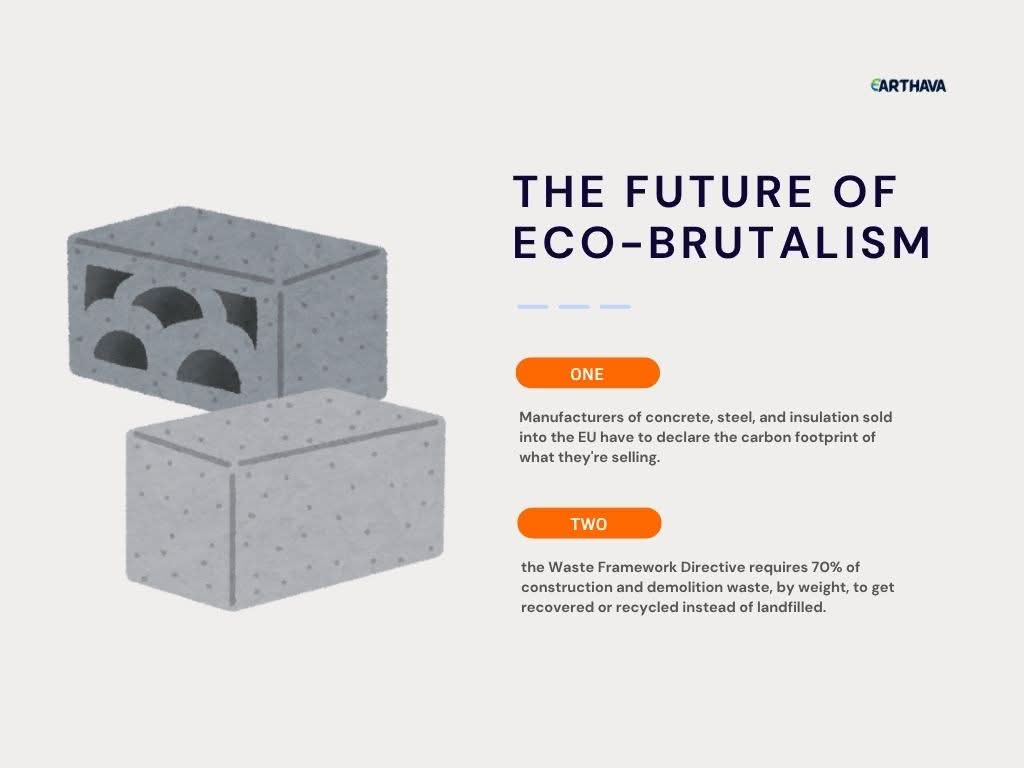
The EU’s revised Construction Products Regulation kicked in this year. Starting in 2026, manufacturers of concrete, steel, and insulation sold into the EU have to declare the carbon footprint of what they’re selling.
Separately, the Waste Framework Directive requires 70% of construction and demolition waste, by weight, to get recovered or recycled instead of landfilled. That’s not a trend piece; that’s just what building in Europe requires now. Everywhere else is watching to see if it spreads.
Mycelium composites are still mostly experimental, grown instead of manufactured, biodegradable once a building’s done with them, but the supply chain for building at any real scale doesn’t exist yet. Same story with a lot of the material innovation in this space.
What’s more likely near-term: passive cooling and solar integration stop being the eco-brutalist flourish and start being what any new concrete building has to do to pencil out on energy costs. Not because architects got more idealistic.
Because energy got more expensive and the regulations stopped being optional.
FAQ
Mostly the scale and the upkeep. Bare concrete stains and streaks as it ages, and a lot of postwar brutalist public housing got neglected by the same governments that built it, so plenty of it ended up looking exactly as grim as people always said it was. The style also got tied to authoritarian state architecture in parts of Eastern Europe, which didn’t help its reputation in the West either.
Not from the English word. It comes from the French béton brut, raw concrete, the material left unfinished instead of covered up. The name described the material first. The reputation for being harsh came later.