


Snap Circuits Green is the pick for most families. Widest range of energy sources, easiest to start with, holds up over time.

For everything else on this list, the answer changes depending on what you want. Outdoor and hands-on, Thames & Kosmos Wind Power. Classroom or long-term reuse, the Renewable Energy Lab. Cheap and messy, Hydropower.
Ten renewable energy educational kits went through the wringer here. Three didn’t make the top picks. The rest, below, sorted by what they actually teach and what they’re worth the money for. Let’s dive in.
Top Picks
| Kit | Best For | Ages | Price Tier | What Sets It Apart |
|---|---|---|---|---|
| Snap Circuits Green Alternative Energy Kit | All-around first green energy kit | 8+ | $$ | Widest range of energy sources in one box, solar, wind, hydro, hand-crank, plus a real electrolysis setup |
| Thames & Kosmos Wind Power V4.0 | Outdoor, hands-on physics | 8+ | $$$ | Real 3-foot turbine, weatherproof, actually powers a small car |
| Thames & Kosmos Hydropower Science Kit | Kids who like getting a little messy | 8+ | $$ | 12 builds, water wheel to hydroelectric station, cheapest way into real renewable physics |
| Thames & Kosmos Renewable Energy Lab | Classrooms, homeschool, long-term use | 8-18+ | $$$$ | Fully modular, NGSS-aligned, the only kit here built to be reused for years, not one project |
| Thames & Kosmos Green Engineering STEM Kit | Teaching one house’s full energy system | 8+ | $$ | Solar, battery storage, heat pump, and lighting all working together in one model home |
| Bottleboom 13-in-1 Solar Power Robots | Rebuilding, no batteries at all | 8-12 | $ | Solar only, 13 robots from one parts bin, genuinely reusable |
| Thames & Kosmos SolarFlower Golden Sunrise | A calmer, decorative pick | 8+ | $$ | Doubles as actual window decor once it’s built, lighter science, better for older kids or a shared project with an adult |
1. Snap Circuits Green Alternative Energy Kit
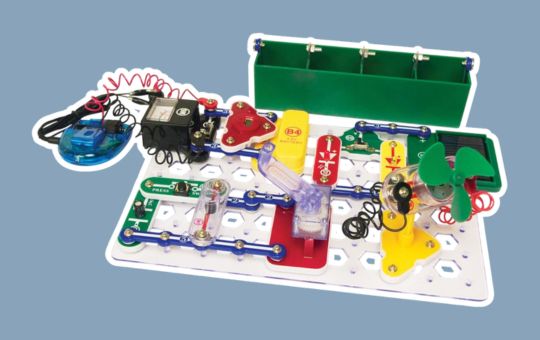
Snap circuits, but pointed at wind, solar, hydro, hand-crank, and a little electrolysis on the side. The kit gives kids the parts to build project that generates the green energy.
Here’s what’s in the box. A solar cell that charges a rechargeable NiMH battery when you set it under a lamp or in a window. A hand crank hooked to a geared motor, so kids feel in their own arm how much effort it takes to make electricity versus how easy it is to flip a switch and use someone else’s. A wind fan and a water wheel that spin a motor and push power into the circuit, same idea, two different sources. And a liquid holder with copper and zinc electrodes dropped in, which is basically a tiny electrolysis setup; kids split water into hydrogen and oxygen and watch bubbles form on each electrode.
There’s a meter in there too, an analog one, so a kid can watch voltage rise and fall as a battery charges or drains. This is the part we keep coming back to. A lot of these kits tell a kid “solar panels make electricity” and stop there. This one hands them a meter and says Prove it.
Everything’s color coded and numbered, snaps onto a plastic grid, no soldering, no tools, and it’s compatible with other Snap Circuits sets if your kid already has one lying around. Comes with the standard full color project manual for the 125-plus builds, plus a separate insert called Think Green that goes over geothermal, hydrogen fuel cells, tidal, and the other energy sources the kit itself can’t fully demonstrate with plastic and wire.
Ages 8 and up. Needs two AAA batteries, not included, easy to forget until you’re standing in the checkout line on Christmas Eve.
Skip it if your kid already has a base Snap Circuits kit sitting in a closet somewhere. A chunk of what’s here, the wires, the grid, some switches, is the same hardware, just repackaged around a green energy theme.
2. Bottleboom STEM 13-in-1 Solar Power Robots

No batteries in this one at all. Set it under a light source, or better, a window, and the gearbox turns on solar alone. That’s the whole pitch, and it’s a different one from the Snap Circuits kit above, where a battery does most of the work and solar is one demo among several. Here solar is the only engine.
One box of gears, plates, tires, and shafts builds 13 separate robots, not 13 versions of the same robot. Kids snap the pieces into a beetle, a dog, a car, take it apart, build something else out of the exact same parts. That reuse is the part worth pointing out, most STEM kits at this price get built once and then sit on a shelf. This one’s designed around rebuilding.
The solar panel tilts, angling it toward the light is how you get the motor turning fast versus barely twitching, so a kid ends up learning the relationship between light angle and energy output just by fiddling with it, nobody has to explain the concept first. A few of the builds move on water too, not only carpet and tile.
Parts are ABS plastic, smooth edges, no sharp corners to worry about. Rated for ages 8 to 12. Comes in a gift box, which matters more than it sounds like if this is going under a tree or wrapped for a birthday.
Worth knowing before you buy: it needs real light. A dim room or an overcast afternoon and the motor barely moves, kids expecting an instant response might get frustrated waiting for the sun to cooperate.
3. Thames & Kosmos Wind Power V4.0

Rated for ages 8 and up. It picked up a finalist nod for The Toy Association’s Outdoor Toy of the Year, which tracks, since “make kids go outside and stay there” isn’t a small thing for a STEM kit to pull off.
Three feet tall once it’s built. This one’s not a tabletop kit, it needs a yard, a balcony, somewhere the wind reaches, so know that going in before you order it for an apartment with no outdoor space.
The turbine has real aerodynamic curves on the blades, not flat plastic fins, shaped to catch wind the way a utility-scale turbine blade does. Stakes come in the box to anchor it to the ground, and the battery box is weatherproof now, this is the fourth version of the kit and Thames & Kosmos redesigned it specifically so the whole rig can sit outside without you dragging it in every time clouds roll in.
Once it’s spinning, the generator lights an LED and charges a rechargeable battery, so a kid sees the wind doing something immediate, not abstract. Then the same generator gets rewired into a motor, and that motor drives a small electric car built from leftover parts in the kit. That reversal, generator becomes motor, stored energy becomes motion, is the lesson here, more than the turbine itself.
Kids also get to mess with blade angle and turbine placement, rerun the experiment, watch the numbers change. The 32-page manual walks through the physics behind it and covers the history of windmills too.
4. Thames & Kosmos Hydropower Science Kit

Heads up before anything else: this one needs water, actual water, in and around the build, so expect a wet table and probably a wet kid by the end of an afternoon. Adult supervision recommended, not because it’s dangerous, more because “kid plus water plus a dozen small parts” tends to end up somewhere the parts weren’t supposed to go.
Twelve experiments come packed into this, and they’re not all the same wheel spun a dozen different ways. Kids build a water wheel, then a sawmill and a hammer mill that use the spinning wheel to do physical work, cutting and pounding motions, the same jobs water power did for centuries before anyone thought to wire it into a generator. There’s a water tower and a set of communicating vessels too, which sounds dry on paper but is really just watching water find its own level between connected containers, a kid can stare at that for longer than you’d expect.
The part that separates this from a basic “build a wheel” kit is the hydroelectric station near the end. Kids wire it up, watch it light an LED, and only then does the manual pull back and explain that the same physics runs dams, tidal barrages, and river turbines that power whole grids. Small plastic wheel, same underlying idea as something the size of a city block.
Full-color, 32-page manual, ages 8 and up, and it picked up a Parents’ Choice Recommended award along the way.
Worth grabbing alongside the Wind Power kit above if you want a kid to compare two renewable sources side by side instead of learning them as separate, unrelated facts.
5. Thames & Kosmos Renewable Energy Lab
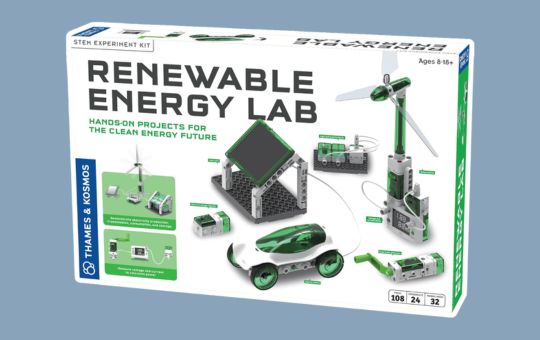
Every kit above builds one thing. This one’s built to hold all of them at once. Solar panel, wind turbine parts, a hand crank generator, gears and wiring you snap and swap into a windmill one afternoon and an electric car the next, same box of parts reconfigured instead of a single fixed build.
NGSS aligned, which matters if a teacher or a homeschooling parent needs the lessons to line up with a curriculum instead of just being fun on their own. Thames & Kosmos built this one for classrooms as much as living rooms, the parts are made to survive being handled by a dozen different kids across a school year, not just one kid over a weekend.
Ages 8 through 18, which is a wide range for a single kit, and it earns that range by scaling the projects, a younger kid can follow the step-by-step build for the LED buzzer while an older one gets into swapping gear ratios and measuring output differences between setups.
Now the number that matters before you add this to a cart: it runs close to $250 direct from Thames & Kosmos, well above everything else on this list. It is not a knock, a kit this modular and this durable costs more to make, but it’s not the pick if you just want one kid to build one wind turbine over a weekend. It’s the pick if renewable energy is going to be a running theme, a whole semester, a science fair project, something that gets reused over time.
If the budget doesn’t stretch that far, the Hydropower kit above teaches a real chunk of the same physics for a fraction of the price, just without the reconfigurable parts or the classroom-grade curriculum behind it.
6. Thames & Kosmos Green Engineering STEM Kit
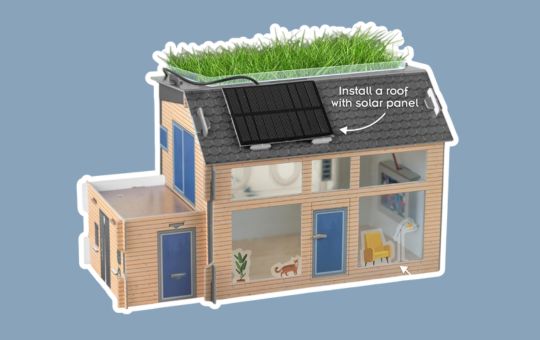
What does an energy-efficient house actually look like, scaled down to something that fits on a kid’s desk? This kit is basically the answer. Kids build a model home, roughly 14 inches long, and outfit it piece by piece with the systems a real green house runs on.
A solar panel feeds a home energy storage battery, so a kid watches energy get generated, stored, then pulled back out later. There’s a model heat pump in there too, LED lighting throughout the house, and even a small electric lawn mower model to round out the “everything in this house runs clean” idea. Around 9 experiments guide the build, walking through questions like what a solar cell is good for, how climate shifts change how much energy a house burns through, and why a living roof helps in ways a normal roof doesn’t.
It’s built with classrooms in mind as much as bedrooms. Thames & Kosmos pitches it directly at teachers looking for a group presentation piece on clean energy, and the scale of it, one house, multiple systems, multiple kids taking turns adding a piece, supports that better than a single-build kit would.
32-page full color manual, ages 8 and up, roughly 17 pieces total depending on the version you land on.
Where this one’s weaker than the Renewable Energy Lab above: it’s one fixed house, not a reconfigurable system. Once the model’s built, it stays built. Great for a focused lesson on a single home’s energy use, less good if you want a kid rebuilding and experimenting with totally different setups over months.
7. 4M Green Science Hybrid Solar Power Water Pump
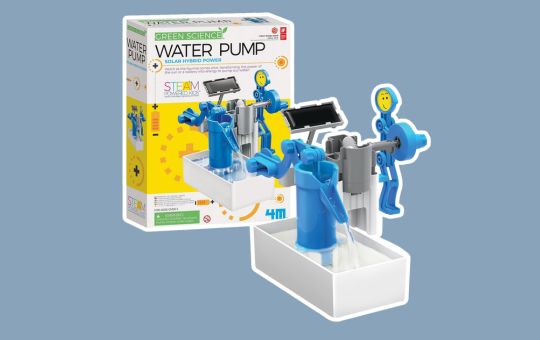
Smallest kit on this list by a wide margin. One build, a little figure that pumps water back and forth, no 13 robots, no reconfigurable house, just one simple mechanism and the two ways to run it.
The parts list is short enough to list in full: a body, a solar panel and its holder, a support arm, a motor, a gearbox, a battery holder, and a pair of wires.
Set it in sunlight and the solar panel drives the pump directly. Move it indoors or catch a cloudy stretch and it switches over to a single AAA battery instead.
Two things aren’t in the box and worth knowing before it ships: a small screwdriver and that one AAA battery. Neither is expensive, but you’ll want them on hand before a kid tears into the packaging expecting to start right away.
Age recommendations are inconsistent depending on where you look, some listings say 5 and up, others say 8 and up.
This isn’t the kit that teaches a kid the full arc of renewable energy the way the Hydropower or Renewable Energy Lab kits above do. It’s closer to a starter, a cheap first taste of “the sun can power something,” good as a stocking stuffer or an add-on gift next to something bigger, not really built to stand alone as the centerpiece.
8. SCAEMO Solar Car Building Kits for Kids Ages 8-14

Four separate builds in one box, each piece individually packaged, not one kit that does four things but four small kits bundled together: a solar powered car, a solar powered plane, a wind powered car, and an electric fan. A kid works through them one at a time instead of all at once.
The power sources split down the middle. The car and the plane run on solar panels wired straight to the motor, no battery needed once they’re assembled. The wind car and the fan need AA batteries, not included, so the “wind” and “electric” halves of this set are really just battery powered models with fan blades or wheels attached, not wind energy in any meaningful sense. Worth knowing that going in if the reason you picked this up was specifically wind power.
Everything’s punch-out basswood, no welding, no glue, parts snap and screw together with instructions walking through each build. That keeps the barrier low, a kid genuinely can do this without an adult doing the fiddly parts for them.
Listed for ages 8 through 14, small parts throughout so it’s not one for younger siblings to wander into.
Where the branded kits above win is consistency, Elenco and Thames & Kosmos back their parts with real engineering and quality control. This one’s a fine budget entry point, four builds for not much money, but temper expectations on fit and finish accordingly.
9. AESGOGO Solar Robot Space Toy Building Kit (6-in-1)
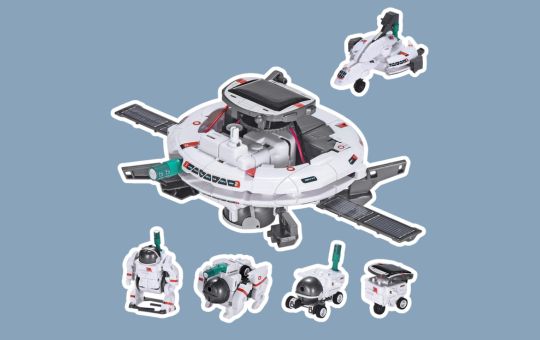
Another solar robot kit, compared directly to the Bottleboom one a few entries back. Where that one built general purpose robots, animals, cars, this one commits to a theme: everything here is space. A kid builds a space station, a robot dog, an astronaut, an explorer, a rover, and a small aircraft, six models from one shared parts bin.
The power setup is the more interesting difference. Bottleboom ran on raw solar only. This one gives each model two forms, a solar panel version and a rechargeable battery version, so the same robot can run under a lamp during the day and off a charged battery after dark. You do need to supply 2 AA batteries to charge that battery module though, they’re not in the box, easy to miss if you’re wrapping this as a gift and don’t check first.
Small parts throughout, sprues to snap pieces off of, a bit of edge smoothing recommended in the manual before assembly starts, nothing that requires tools beyond patience. Listed anywhere from ages 7 to 13 depending on the retailer, so treat the low end of that as “with a parent nearby” and not fully independent.
It won’t hold up the way an Elenco or Thames & Kosmos kit does over repeated use, the plastic and fit feel closer to what you’d expect from a budget import. But for the price, six distinct builds and a real solar-versus-battery comparison built in makes it a reasonable pick for a kid who’s more into space than circuitry for its own sake.
10. Thames & Kosmos SolarFlower Golden Sunrise
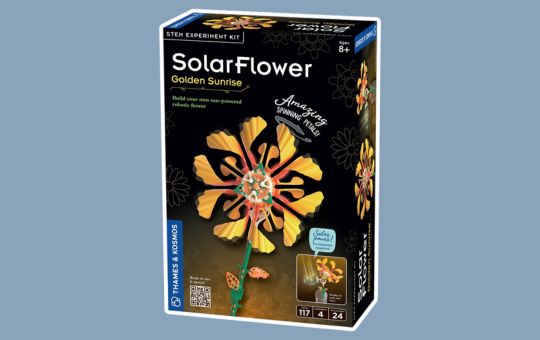
Petals that spin on their own, no motor sound, no batteries, just a solar panel stuck to a window and a flower quietly turning in the light. It’s less a build-and-test kit and more a kinetic sculpture that happens to teach real mechanics along the way.
Under the petals sits a small motor running through planetary gears, and that’s the basic lesson, gear ratios and how a solar cell’s output translates into physical motion. It’s a lighter science lesson than most of the kits on this list, closer to “watch the mechanism work” than “run experiments and record results,” worth knowing going in if you want something with more structured learning behind it.
The solar panel attaches with a suction cup, either straight to a window or onto the flower’s own stem, so it doubles as a genuine piece of desk or window decor once it’s built. That’s actually the pitch, Thames & Kosmos markets this one for kids and adults both, and assembly reads more as a relaxing afternoon activity than a race to finish a project.
Petals swap between different SolarFlower sets too, so a family that picks up more than one color ends up with a small system for mixing and rebuilding, rather than a single fixed model.
Ages 8 and up. If you want a kid who’s already worked through wind turbines and hydropower wheels to end on something quieter, calmer, more about craft than circuitry, this closes the list out well. If you want rigor over aesthetics, one of the Thames & Kosmos experiment kits earlier in this list will teach more per dollar.
The Importance of Renewable Energy Education
Teaching about renewable energy is crucial in today’s world. It promotes awareness of our environmental impact and the need for sustainable solutions.
Young minds are curious and eager to learn about how the world works. Introducing them to renewable energy early on can inspire future innovation.
Education in this field helps develop critical thinking skills. It prepares young learners for the environmental challenges they may face in the future.
What Are Renewable Energy Educational Kits?
Renewable energy educational kits are hands-on learning tools. They make complex concepts accessible to young learners through engaging activities.
These kits often include components to build working models. Students can create miniature wind turbines and solar panels, learning about real-world applications.
Through practical exploration, young innovators grasp the basics of renewable energy. This experience lays a strong foundation for further study in sustainable technology.
Wind Energy Projects for Aspiring Engineers
Wind energy projects intrigue young engineers. Kits provide the parts and guidance needed to build functional models.
Constructing a wind turbine teaches how wind generates electricity. Students learn about turbines’ mechanisms and efficiency.
These projects boost problem-solving skills. Young learners get the chance to test, modify, and improve their designs through experimentation.
Solar and Wind Power Kits: A Dual Approach
Solar and wind power kits offer a holistic learning experience. By combining both, students understand different energy sources.
Working with photovoltaic cells, they see how sunlight becomes electricity. The hands-on process solidifies these concepts practically.
This dual approach enhances comprehension. It allows students to compare and contrast different renewable energy technologies, fostering deeper insight.
Benefits of Using Educational Kits in Learning
Educational kits offer hands-on learning experiences. They help bridge the gap between theory and practice in renewable energy understanding.
Students enjoy experimenting with real components, which brings science to life. This active participation boosts retention and enthusiasm.
Using these kits, learners grasp complex ideas in fun ways. The practical approach supports diverse learning styles, benefiting all students.
Encouraging Critical Thinking and Creativity
Educational kits challenge students to solve problems. They must think creatively to design and refine their models effectively.
This process fosters critical thinking. Learners are encouraged to analyze and make informed decisions while experimenting.
Aligning with STEM Education Goals
Renewable energy kits align with STEM goals. They provide tools to explore science, technology, engineering, and math hands-on.
These kits inspire potential STEM careers. By engaging with renewable energy, students see the relevance of STEM in sustainability.
Choosing the Right Kit for Your Young Innovator
Selecting the perfect kit involves understanding your child’s interests. Consider their curiosity in wind or solar power and match it to the kit.
Assess the kit’s complexity relative to the child’s age. Ensure it challenges but does not frustrate, promoting steady growth.
Read reviews from other parents and educators. This can provide insights into the kit’s effectiveness and engagement levels among similar age groups.
Considerations for Age and Skill Level
Age is crucial when picking a kit. Kits should match your child’s developmental stage for effective learning.
Choose kits that accommodate skill levels. Starting simply allows building confidence before progressing to advanced projects.
Safety and Durability of Kits
Durable kits withstand repeated use. Quality materials ensure long-lasting educational value and safe handling.
Safety is key for young learners. Choose kits with non-toxic parts, focusing on child-friendly designs and sturdy construction.
Conclusion
Renewable energy educational kits empower young minds to understand sustainable solutions. They spark curiosity, enhance skills, and inspire future eco-leaders.
These kits are more than toys. They’re tools that shape the innovators of tomorrow, merging learning with the fun of discovery.
FAQ
Depends a lot on which one. The 4M water pump’s under 25 bucks, basically pocket change. Most of the list sits somewhere between 30$ and 100$, that’s where Snap Circuits Green and the Hydropower kit land. Then there’s the Renewable Energy Lab, which runs close to 250$, so if you just want a solid kit and don’t need it to last forever, go for kits under 50$. If you want something that grows with a kid, the pricier one earns it.